
Dr Andrew M. Henry PhD, is a “scholar of religious studies.” He has a popular You Tube channel dedicated to “improving the public’s religious literacy”.
Usually he covers slightly off-beat religious topics in a serious but approachable manner. I’ve watched quite a few videos of his over the last few years, and expected him to take a sensible approach to his recent video on a topic that I have covered extensively here since 2009 — the deadly dangerous scam known as the law of attraction, The Secret, Positive Thinking, manifesting.
To be clear, I can easily understand why people encountering this scam for the first time don’t immediately recognise the dangers — that’s the whole point of manipulative scams– they mimic something harmless. But I have absolutely no patience whatsoever for someone who presents himself as a serious academic and then plays dumb — very dumb — about the very clear and very well documented trail of destruction this scam has left behind it.
It turns out that he is in fact himself promoting a law of attraction scammer, with whom he shares a sponsor. I assume that fellow is promoting him back. Uncritical cross-promotion is of course one of the manipulative techniques that scammers love. It encircles the customer in a net of scammers who all endorse each other, isolating them from critical voices.
Well, here is my attempt to break through that encirclement. Dr Henry said nothing about its victims. Not a word about the open invitation to fraud, quackery, ruthless manipulation, and pointless risk-taking that this scam involves. And nothing about the psychological dangers of believing the ideas it is based on.
And despite being a scholar of religious history, he promotes the New Age hit film The Secret without mentioning that it is squarely based on a febrile (and borderline anti-semitic) conspiracy theory.
Dr Henry, I must inform you that there is no secret cabal of rich men who used this secret knowledge to get rich. They are not going to kill Rhonda Byrne. And Albert Einstein was not secretly an alchemist. You don’t need to stay “neutral” about any of it. It is not “a matter for theologians to decide”.
And if The Secret’s version of history is right, then everything you wrote in your PhD thesis is wrong. Same for anthropology, sociology and archaeology, which you claim are your academic fields of interest. All of it wrong. Same for the whole of physics — it would all be overturned root and branch if the law of attraction really exists. Maybe Rhonda Byrne will invite you to give her acceptance speech to the Nobel Committee.
In other words, Dr Andrew M. Henry has made a fool of himself peddling pseudo-science and promoting a deadly scam. And he is trying to make some quick cash by endangering his own audience. His support for all this is an invitation to the most ruthless and dangerous scammers to use his PhD-status to reinforce their credibility.
He clearly doesn’t realise how deeply he’s been suckered into this manipulative fraud. Nor do the other academics he features in his video realise how dangerous and stupid it is promote this kind of thing under the cloak of it being “woman-friendly”. For heavens sake you idiots — it’s marketed at women. It targets disempowered women, especially single mothers, for exploitation. And it places everyone who gets drawn into its seductive web in imminent danger.
It only looks harmless if you refuse to consider the harm.
And Dr Henry refuses to consider the harm.
So let’s have a brief look at what Dr Henry conceals from his audience.
…
James Arthur Ray — Star of The Secret and 3 Time Killer
James Arthur Ray shot to stardom in 2006 after he appeared in The Secret. Oprah invited him onto her show and instantly turned him into a mega-star with a vast new audience. Then in 2009 he killed three of his customers and was sent to jail.
Oprah never apologised for setting a killer loose on her audience.
And I don’t expect Dr Henry will do so either. Instead he repeatedly features Oprah’s blessings for The Secret, without breathing a word about the victims or the crimes.
This is not just a case of a bad person who happened to also believe in the law of attraction. Witness testimony shows that Ray believed his victims had manifested their own deaths, and that he was therefore absolved of all responsibility. He cooked three people to death in a bogus sweat-lodge, which he had deliberately overheated, and from which there was no escape.
Later that night, with a couple of dozen people airlifted to hospital in a critical condition, and two already dead and one to die later on life support, Ray sent out an email to his mailing list reporting, in true positive thinking style, that the event had been “a success”.
Below is a screen shot of Ray’s first appearance in The Secret.
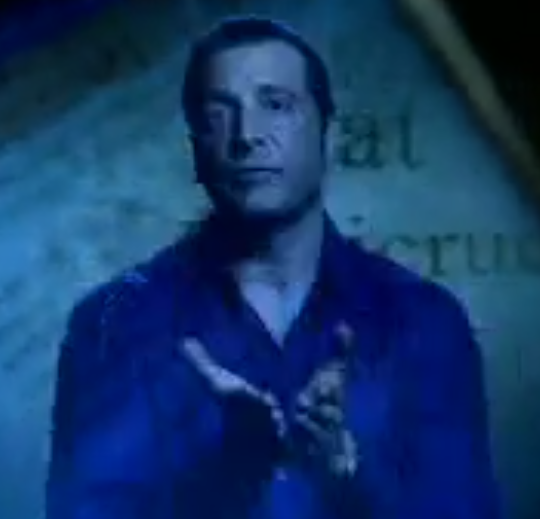
It’s a subliminal image, briefly flashed at viewers at a climactic moment at the end of the opening sequence. For some of his victims, this was probably the first they ever saw of him — and they didn’t even register it. Now thanks to Dr Henry it will again be for some people their first — subliminal — exposure to this convicted killer, as he tries to rebuild his post-prison career.
It is also worth noting that both the investigating officer and the state prosecutor were awake to the dangers of manipulative persuasion.
They had specialist training in investigating child abuse, which helped them recognise the manipulative practices that Ray was using. They were not thrown off the investigation by his attempts to frame it as “an accident”. (Three months earlier the San Diego police had been persuaded by Ray’s staff not to investigate the death of a participant at one of his events. The story behind that is even more sickening than the deaths which he was locked up for.)
Dr Henry says nothing to his audience about manipulation, despite its obvious and widespread usage by law of attraction teachers.

Detective Ross Diskin with James Ray– not much attraction, plenty of law
…
Louise Hay — Deadly Cancer Quack
Dr Henry introduces to his audience the deadly cancer quack Louise Hay. (As is usual for famous New Age swindlers, she was also promoted by Oprah.)
Somehow, Dr Henry manages to spend several minutes promoting Louise Hay without once mentioning her claims about having a cure for cancer. Yet that is exactly what she’s famous for.
Instead, he shows some footage of her from the 1980s when she was an AIDS quack for a brief period, but he doesn’t mention AIDS either — nor leprosy, nor muscular dystrophy or leukemia or any of the other illnesses she claims to know how to heal. Instead he presents Hay merely as someone whose religious beliefs include the notion that “You are 100% responsible for all that happens to you.”
Hay of course belonged to the fanatical Christian Science Church. For Dr Henry this gives her diplomatic immunity as a devout Christian. He does note that some people believe that sociological and genetic factors also play a role in people’s lives, but remains neutral on where he stands in this regard.
Again Dr Henry, the serious academic, chooses to play dumb. He must know that Hay’s story falls apart as soon as it’s checked, and that’s probably why he avoids even mentioning it. It would instantly derail his entire feel-good chummy promotion of these ghouls, quacks and fraudsters.
Louise Hay of course, claimed to have healed a malignant tumor using positive thinking. She said that the doctors were amazed. This is the basis of her entire business: selling her miraculous healing method, proven to work by her own healing story. She made millions from it and set up a vast publishing empire promoting other quacks and quack-cures.
But let’s back up a bit. She said that she healed her cancer in 1978 or 79 — she can’t remember which. The doctors who diagnosed it as terminal? She can’t remember their names. What stage was her cancer at when she healed it? She can’t remember.
Four years earlier, in 1975 she had published a book claiming you can cure cancer using positive thinking. Then she “got cancer” and “healed it” using her method…. But didn’t think to keep any photos or documents or letters or anything else that would prove this healing miracle which she had already predicted.
Is there any evidence that she cured her own cancer? No.
Is there any evidence that she even had cancer? No.
Is there any evidence that positive thoughts cure cancer? No.
Is there any evidence that negative thoughts cause cancer? No.
Did Dr Andrew M. Henry PhD mention any of this to his audience? No.
…
The POWER of Positive Thinking
The next thing Dr Henry wants to remain neutral about is Donald Trump.
Trump’s pastor and life long friend was Norman Vincent Peale, the inventor of the hideous prayer-based scam, The Power of Positive Thinking, from which the law of attraction sprouted. (Basically the law of attraction is Peale’s positive thinking, only with fake quantum physics in place of Jesus.)
Dr Henry shows some interesting footage of Trump saying Peale was “the greatest public speaker”. But of course, he says nothing about the possibility that Trump practices Peale’s methods, even though much of Trump’s most distinctively odd behaviour accords perfectly with Peale’s teachings.
(For example — Trump’s otherwise baffling pronouncement that John McCain was not a war hero “because he got captured”. McCain must have been so scared of getting captured that he manifested it, the big cry-baby. Same with Trump’s disdain for victims of natural disasters.)
Believing you can use positive thinking to “create your own reality” would explain Trump’s refusal to plan anything in advance and just improvise policy on the hop. (It works surprisingly well as long as you can maintain dominance and are insulated from the consequences. It knocks everyone else off balance and creates chaos, amidst which he is the only one looking calm and in control.)
Narcissistic self aggrandisement, a psychopathic loathing of victims, and a profound detachment from reality, all of which line up perfectly with positive thinking….
How might all of that combine with access to nuclear weapons? Or inciting mass political violence?
Dr Henry doesn’t think it’s worth discussing, and passes over it in silence.
…
Some people might recall how during the pandemic, Trump was confused by covid testing. He couldn’t understand how a “negative” test could be a good thing, and wound up saying that he had “tested negative, but in a positive sense”.
This brings us to the next topic– the psychological effects of dividing up thoughts, emotions and events into “positive” and “negative”.
Mental Health and Polarising Reality into Positive & Negative
Dr Henry opens his stupid video with the idea that humans are “magnets” for the events that befall them, because “like attracts like.” (Of course magnetism is the attraction of opposites, but Henry plays dumb about that too.)
Dr Henry probably knows that this stupid idea is derived from medieval alchemy, where it was not stupid at all. It involves the “law of correspondences”, and “doctrine of signatures”, in which microcosm reflects macrocosm. So the human body (microcosm) reflects the cosmos (macrocosm). The vast and elegant system of alchemy should be right in Dr Henry’s academic wheel-house. He must know that The Secret is a crass and manipulative distortion of it, but as usual, he holds his tongue.
But what of the psychological effects of believing that some thoughts are “positive” and have a positive electrical charge, and that others are negative and have a negative charge…. And that these electrical charges literally “attract” objects and events that also — somehow — carry the same electrical charge.
This is the law of attraction.
So if you have a positively charged image of a positively charged Lamborghini, (or bicycle, or sex partner, or parking space, or state of health), that thought will draw the desired object or event towards you as surely as night follows day. It’s the LAW.
And the same holds true for “the negative”…….. And that is where it all gets very very scammy and manipulative.
IF YOU GET SCARED YOU WILL ATTRACT YOUR FEARS INTO YOUR LIFE.
This is the threat that lurks in the background of this grotesque and evil scam.
The sellers promise you that you can have everything you want….. But if you don’t learn from them how to use this power positively, you will manifest your worst fears instead. What’s more, if you doubt, question or criticise it, your “negativity” will ruin your life or end it.
Louise Hay’s fans have repeatedly told me I will get cancer because I have criticised her. Rhonda Byrne says explicitly that all criticism is “negativity” and must be shunned.
It creates a culture in the “positive thinking” community in which criticism is shunned and authority dominates. Consumer protection is non-existent and unthinkable.
I have no idea why Dr Henry himself obeys these rules so doggedly in his video, but he most certainly does. This is how manipulation works, ladies and gentlemen. Dr Henry has submitted himself to the unwritten laws, and probably doesn’t even realise it.
…
The Business Model — Exploitive, Manipulative, and Refined Over Decades
It should be clear at this point that anyone who sets up a normal business hoping to use their non-existent powers of manifestation to make it work, will probably fail. This is not true, however, for those wanting to set up a business based on flogging the law of attraction to others.
Dr Henry and his academic colleagues think this is great. They list three types of business that all combine well with running a law of attraction scam. These are also especially well suited for women to use to exploit other women, yay!!!
Each of these, by some extraordinary coincidence, is structured to be exploitive, and is an open invitation to further scamming. Of course, none of these highly qualified academics bother warning people about any of the dangers.
1. Multi-level marketing
This is a hierarchical model, in which the top few percent can make astronomical profits (seeming to confirm their skill in manifesting), while the vast majority lose their money. It’s a deliberately exploitive structure, though it looks easy to get into and “start your own business”.
To work, it would require an infinitely expanding population of fully grown adults in your ‘downline’.
2. Health products
Ideal for your own multi-level marketing business. Also an open invitation to flogging quack cures.
3. Life Coaching
This is of course a growth industry, well suited to people with a dominant personality. All you need is a quack therapy, like for example, law of attraction counseling. People will pay you to help them stay on course and avoid manifesting their worst deadly fears.
…
What Dr Henry Learned from The Secret — Uncritical Cross-Promotion
As noted, Dr Henry ends the video by endorsing a law of attraction scammer with whom he shares a sponsor. I assume that fellow (Joe Scott) is returning the favour. This kind of uncritical cross-promotion is a classic scammer tactic. It shares market networks and gives the impression of a legitimate tried and tested track record.
This is the final layer that’s wrapped around this manipulative scam. The customer is encircled in a net of mutually confirming voices, to the exclusion of criticism and consumer protection standards.
This whole set up has been fine tuned over many decades. It started with (ex-Scientiologist) Werner Ehrhard, was refined by (ex-Scientologist) Tony Robbins, and was inherited by people like (ex-Scientologist) James Ray and (ex-Mormon) Esther Hicks, and (ex-Amway salesman) Gerry Hicks.
Those who inherit this slick and monstrous business plan today often don’t know about the trail of destruction it has left in the past and will inevitably leave in the future. They do, however, notice that it all runs surprisingly smoothly — as long as they don’t risk their own money or health, and only get their customers to test it on themselves.
Usually the people who are drawn into this net, are intelligent and decent people who only want the best for themselves and their loved ones. They are usually so focused on self-improvement or dealing with emotional pain, that they don’t hear the clicking of the gears as the scam gets ratcheted up tighter and tighter.
Having a supposedly respectable academic like Dr Henry similingly assure them that everything is fine, just makes it even harder to see what they are being drawn into.
Dr. Andrew M. Henry will probably make a bit of that easy viral cash out of this, but he is being an idiot and trashing his own stated aims for his “educational” You Tube channel–
dedicated to the academic, nonsectarian study of religion. We promote improving the public’s religious literacy by exploring humanity’s beliefs and rituals through an anthropological, sociological, and archaeological lens.
Don’t expect a retraction or an apology from this ex-academic for his ludicrous and spineless profiteering. As the prophet said, Money doesn’t talk, it swears.
…
Article by Yakaru


 Spirituality is No Excuse